
A shopper is interested enough to ask a question. That is not a weak signal. It is one of the clearest signs that they are close to buying.
They want to know whether the jacket fits small. Whether delivery will arrive before Friday. Whether the product works with something they already own. Whether returns are free. Whether the size they need is actually in stock.
If your store answers quickly, the question becomes part of the buying journey. If it makes them search through product tabs, policy pages, and contact forms, the question becomes friction. Many shoppers do not wait for friction to be resolved. They leave.
This is where a lot of Shopify stores lose sales without noticing.
The Problem Is Not Always the Cart
Store owners often look for abandoned cart problems at the checkout. Payment options, discount codes, shipping fees, form fields, trust badges. Those things matter.
But many shoppers never reach the cart. They leave earlier, while they are still deciding whether the product is right for them.
That stage is harder to measure. There is no abandoned checkout email. No failed payment event. No support ticket. A visitor lands on a product page, hesitates, opens another tab, and disappears.
The cause is often simple: they had a question the page did not answer clearly enough.
Product pages are built for the average shopper. Real shoppers arrive with specific doubts. A parent buying a gift wants to know if it is suitable for a certain age. A customer buying clothing wants fit reassurance. Someone ordering before a trip wants delivery certainty. Someone comparing two products wants help choosing between them.
If the answer is not obvious in the moment, the store has asked the shopper to work harder than they expected.
The Questions That Decide the Sale
Pre-purchase questions are rarely dramatic. They are practical, specific, and time-sensitive.
Product fit and compatibility. Will this fit a 13-inch laptop? Does this charger work with my model? Is this suitable for sensitive skin? These are not curiosity questions. They decide whether the product is safe to buy.
Stock and variant availability. Is the medium actually available? Will the black version come back soon? Can I order two of these today? If the answer depends on live inventory, a static answer is not enough.
Delivery timing. Can this arrive before the weekend? Do you ship to Germany? Is express delivery available for this item? Delivery confidence is often the difference between buying now and looking elsewhere.
Returns and exchanges. Can I return it if the size is wrong? Who pays return shipping? Can I exchange instead of refunding? Return uncertainty makes shoppers cautious, especially on first purchases.
Product comparison. Which version is better for travel? What is the difference between these two bundles? Which one is best for beginners? Comparison questions show intent. The shopper is not browsing randomly. They are choosing.
The store that answers these questions in the session keeps the shopper moving. The store that makes them email support turns a buying moment into a waiting period.
Why Contact Forms Do Not Help Here
A contact form looks like a solution from the store owner's side. The shopper can ask anything. The team can reply later. Nothing gets missed.
From the shopper's side, it feels very different.
They are not trying to start a support thread. They are trying to decide whether to buy now. A reply tomorrow may be accurate, but it arrives after the decision window has closed.
This matters most when the shopper is comparing options. If your store says "we will get back to you" and a competitor answers immediately, the competitor has not just provided better service. They have removed uncertainty while the buyer is still active.
For lower-cost products, many shoppers will not send the form at all. The effort feels too high relative to the purchase. For higher-cost products, they may send it, but they keep researching in the meantime. Either way, the store has lost control of the moment.
Search and FAQ Pages Only Solve Part of It
Good product pages, filters, FAQs, and policy pages are still important. They give shoppers a place to verify information and they give your store clear source material.
But they do not fully solve the problem because shoppers do not always ask in the way your site is organised.
Your shipping page may explain delivery zones by country. The shopper asks, "Can this get to Amsterdam by Friday?" Your size guide may list measurements. The shopper asks, "I usually wear a UK 10, should I size up?" Your product comparison chart may list features. The shopper asks, "Which one should I buy for a small apartment?"
These are not failures of content. They are failures of format. The information may exist, but the shopper still has to translate their situation into your structure.
An AI assistant is useful here when it can bridge that gap. It should understand the shopper's question, use the store's actual content, check live data when needed, and answer in plain language.
The Answer Has to Be Accurate, Not Just Fast
Speed alone is not enough. A fast wrong answer is worse than no answer.
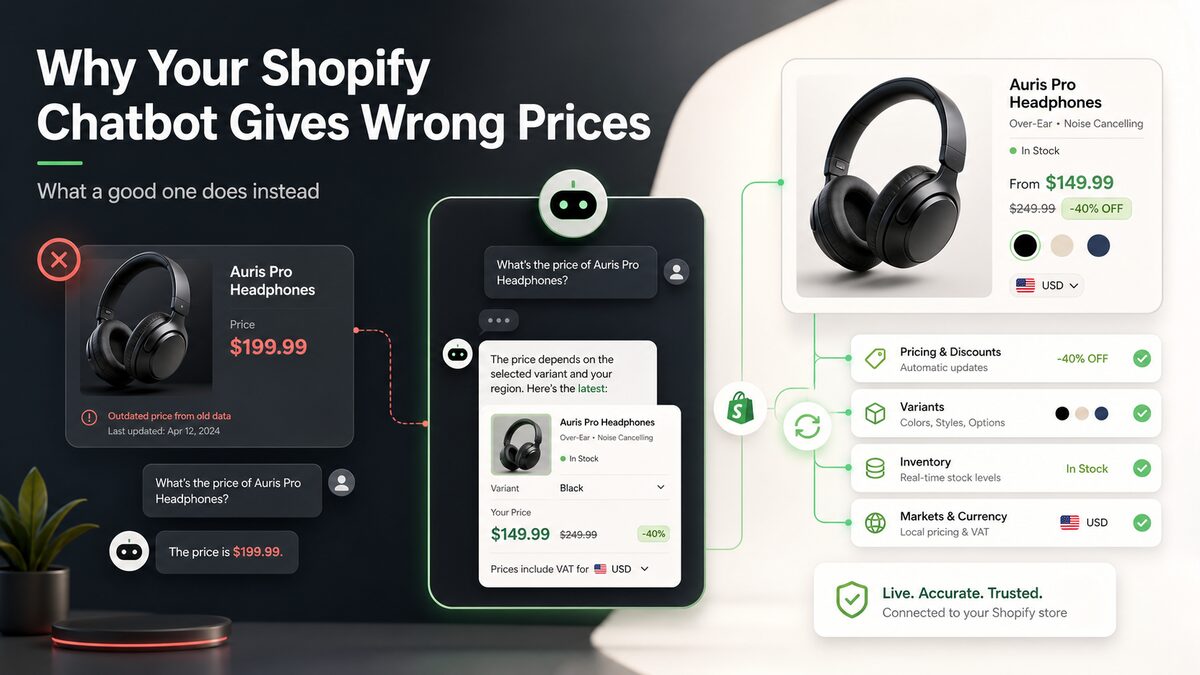
For Shopify stores, accuracy depends on knowing which information can be learned and which information must be checked live. Product descriptions, sizing advice, materials, shipping policy, and return rules can usually be learned from store content. Prices, stock levels, variant availability, and order status should be looked up from the store at the moment the shopper asks.
That distinction matters because pre-purchase questions often mix both.
A shopper might ask, "Is the navy medium in stock, and will it arrive before Saturday?" The answer needs live inventory plus shipping rules. Another might ask, "Which backpack is best for a weekend trip under EUR100?" The answer needs product understanding plus current pricing.
A useful assistant does not guess. It checks what can change, explains what it knows, and hands off when the question needs a person.
What This Changes for the Store Owner
The goal is not to replace customer support. It is to stop making support the first step for questions that should be answerable immediately.
When pre-purchase questions are handled well, three things improve.
First, shoppers get confidence before they leave the page. The product feels less risky because their specific doubt has been answered.
Second, support teams spend less time repeating the same basic information. They can focus on complicated orders, complaints, and edge cases instead of answering "do you ship to France?" ten times a week.
Third, store owners get better visibility into what shoppers are unsure about. If people keep asking about sizing, the size guide needs work. If they keep asking about delivery cutoffs, the shipping page is unclear. The questions are content feedback, not just support volume.
This is one of the overlooked benefits of a good store assistant. It does not just answer shoppers. It shows you where your store is creating doubt.
The Takeaway
Shoppers do not abandon purchases only because they dislike the product or the price. Many leave because one practical question stayed unanswered for too long.
The question may look small: delivery timing, return cost, fit, compatibility, stock, comparison. But at the buying stage, small uncertainty is enough to stop momentum.
For Shopify stores, the fix is not more popups or louder discounts. It is better answers at the point of hesitation.
If your store can answer pre-purchase questions with the same accuracy and speed as a good shop assistant, fewer buying moments turn into silent exits.
See how CYBOT helps Shopify stores answer shopper questions from live product data ->